Dr Ellen Scally, Postdoctoral Researcher, University College Cork
We’re excited to present the first post of our special four-part blog series featuring insights from DARIAH-IE’s 2026 Early Career Researcher Bursary awardees.
DARIAH-IE was delighted to be able to support four Early Career Researchers to attend the DARIAH Annual Event, which took place in Rome, Italy in May 2026. As well as attending the event and benefiting from the networking and learning it offered, the awardees were given the opportunity to provide a short blog about their own work to share with fellow Irish Digital Arts and Humanities researchers on the DARIAH-IE website.
All the posters and presentations mentioned by Ellen can be found in DARIAH’s Digital Arts and Humanities With and For Society: Building Infrastructures of Engagement community collection on Zenodo.
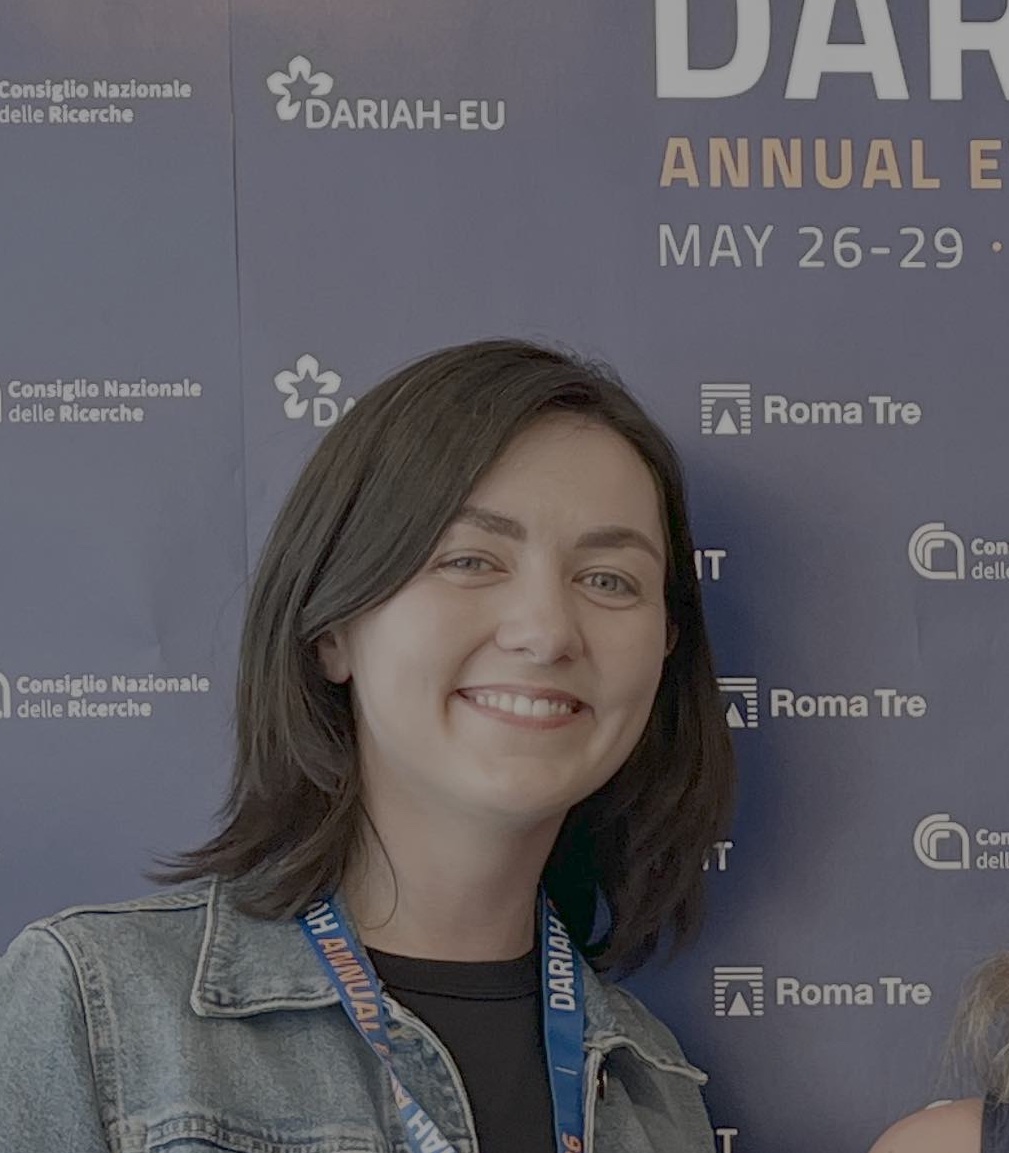
Dr Ellen Scally at the DARIAH Annual Event in Rome [Photo Credit: 911 Foto (https://www.911foto.it/), CC-BY]
DARIAH Annual Event: Infrastructures of Engagement
Dr Ellen Scally
In this global moment of seeming AI and LLM supremacy, the 2026 DARIAH Annual Event theme of “Infrastructures of Engagement” offered the possibility of reprieve, promising some reflection on the ways in which collaboration across academia, cultural institutions and society on digital projects can help to build communities and benefit the public.
This was my first DARIAH event, and I was particularly motivated to attend by the idea that its theme would result in some insight into the ongoing trend in the humanities toward geospatial mapping. One of the ways in which this trend has manifested in film studies has been as a means of bringing new attention to little-known or marginalised production and exhibition practices. Existing and ongoing projects include a map of historic cinema locations, and one which shows amateur film club and society activities across different regions (the Amateur Movie Database). As an amateur cinema scholar, I was keen to learn more about the possibilities and challenges of these approaches, and to think about how mapping might contribute to future research on amateur film culture.
One of the sessions that particularly stood out was the very first panel, Collaborative Cartographic Infrastructures: Public Engagement and Spatial Humanities, which explored the opportunities and limitations of mapping as a research method. Rather than presenting maps as objective or neutral representations of space, the papers highlighted the ethical questions that inevitably arise when deciding how place is represented. Attention was drawn to the practical obstacles that complicate geospatial mapping projects. Historic maps, for example, have often not been digitised or survive only in poor-quality reproductions, making them difficult to integrate into digital projects. Elsewhere, maps themselves become sites of geopolitical contestation, reminding us that spatial data is rarely straightforward and that cartographic infrastructures are shaped by political as well as technical considerations.
What I found particularly refreshing was the emphasis on mapping as a collaborative and community-led endeavour, rather than one which is purely scholarly. A paper on “mapathons” as participatory cartographic practices, focusing on the projects Mapathon 1571 and Schelde-Mapathon, demonstrated how community members can actively contribute to the creation and enrichment of spatial datasets. These initiatives produce valuable research resources while simultaneously creating opportunities for participants to learn new digital and archival skills. They also enable scholars to draw upon local knowledge, memory and expertise that might otherwise go unrecognised or undocumented. The session opened my eyes to the potential of community-driven and participatory scholarship as tools which can benefit the public and reinforce knowledge sharing.
The discussions across four days at the 2026 DARIAH Annual Event offered a valuable counterpoint to narratives that position AI as the inevitable future of humanities research. Instead, contributors repeatedly demonstrated that digital infrastructures can also be imagined as social infrastructures, which depend on collaboration, trust and shared expertise. My first DARIAH event gave me a richer understanding of the methodological and ethical complexities of geospatial research, but also a renewed appreciation for the ways in which participatory approaches can strengthen both scholarship and public engagement. I left Rome with a determination to embed some of the participatory and community-centred approaches discussed at DARIAH into my own projects on local and regional cinema cultures in Ireland.
Biographical note
Dr Ellen Scally recently graduated with a PhD from the Department of Film & Screen Media at University College Cork. She is a former graduate of the MA in Film & Screen Media at UCC. Her PhD project concerned the history of amateur film and cine-culture in Ireland, and research interests include Irish cinema history, amateur film practice, community cinema, and the audio-visual archive. Her PhD project was awarded an Irish Research Council Government of Ireland Postgraduate Scholarship and, in 2025, she was a fellow at the Centre for Advanced Internet Studies in Bochum, Germany. She is a co-organiser of Haunted Futures, an annual interdisciplinary conference at University College Cork.view and modes of collaboration, building our own network of idea exchange that we hope continues long beyond the end of the event.