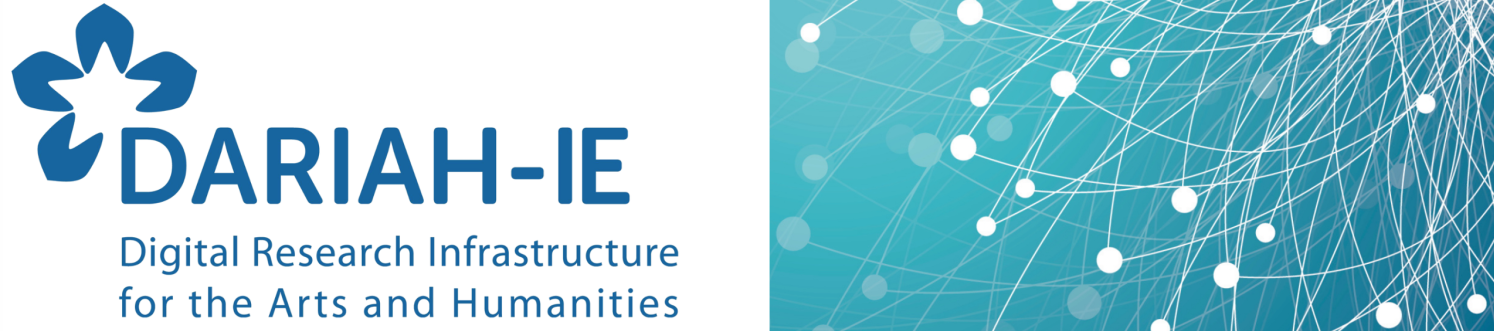
The Research Sustainability Workflow for the Humanities provides flexible, practical guidance that acknowledges and accommodates the varied nature of Humanities research. The workflow offers adaptable tools and strategies that researchers can use to design and share outputs to be sustained for different needs and timeframes. It also centres the importance of developing partnerships to support research dissemination and engagement, highlighting the importance of repositories, publicly funded institutions and cultural communities as stewards of data with continuing cultural and social value.
The Research Sustainability Workflow is published on the SSH Open Marketplace (SSHOMP) in partnership with the Digital Repository of Ireland. A printable version is also available in the DARIAH Zenodo community collection.
DARIAH-CAMPUS

DARIAH-Campus is a discovery framework and hosting platform for learning resources. Providing trustworthy, reusable, open learning resources for learners and trainers. https://campus.dariah.eu/
Social Sciences & Humanities Open Marketplace
The Social Sciences and Humanities Open Marketplace is a discovery portal which pools and contextualises resources for Social Sciences and Humanities research communities: tools, services, training materials, datasets, publications and workflows. The Marketplace highlights and showcases solutions and research practices for every step of the SSH research data life cycle. https://marketplace.sshopencloud.eu/
Transformations – A DARIAH Journal

Transformations: A DARIAH Journal
The first set of peer-reviewed articles in its inaugural issue is dedicated to the theme of Workflows.
For access to the published articles and updates on upcoming calls, visit: https://transformations.episciences.org.
Digital Humanities Course Registry

The Digital Humanities Course Registry is a curated platform that provides an overview of the growing range of teaching activities in the field of digital humanities worldwide. The platform is a joint effort of two European research infrastructures: CLARIN-ERIC and DARIAH-EU
INEO
Ineo is a distributed research infrastructure for the humanities and social sciences giving researchers access to large collections of digital data, innovative and user-friendly applications for the processing of these data and supporting resources like standards, workflows and learn materials. Resources are managed in a sustainable manner by CLARIAH (Common Lab Research Infrastructure for the Arts and Humanities) to guarantee their stability and support long term use by
ReIReSearch
ReIReSearch addresses the growing need of scholars in Religious Studies to discover more data, regardless of location with a platform where disparate digital resources and databases are searchable in a unified and standardised way. It’s a discovery platform bringing together metadata from different collection holders or data providers.